Search for:
Business
Boost Your Business: Simple Email Templates to Save Time

The Ultimate Guide to Email Templates Every Small Business Needs

When it comes to small business success, communication is everything. One of the most powerful tools in your communication arsenal is email. Whether you’re reaching out to clients, following up on leads, or nurturing long-term relationships, having the right email templates can save you time and help you connect effectively.

Business
Business

But let’s face it: crafting the perfect email can feel daunting, especially when you’re juggling a hundred other tasks. That’s why we’ve put together this guide featuring a mix of 34 must-have email templates and 23 proven examples to inspire you. Whether you’re a startup or a seasoned small business owner, these templates will help you engage your audience, build trust, and drive results.


Why Email Templates Matter

Think about it: how many times have you spent 20 minutes staring at a blank screen, trying to find the right words? With ready-made email templates, you can:

  • Save time: Focus on running your business instead of rewriting the same email.
  • Maintain professionalism: Ensure every email is polished and consistent.
  • Improve response rates: Well-crafted emails are more likely to get opened, read, and acted upon.

Let’s dive into some real-world scenarios where these templates can make a big difference.


1. Welcome Emails: Make a Great First Impression

When a new customer signs up, your welcome email sets the tone. Think of it as a digital handshake.

Example Template:
Subject: Welcome to [Your Business Name] – Let’s Get Started!
Hi [Customer’s Name],
Thank you for joining the [Your Business Name] family! We’re thrilled to have you on board. To get started, here’s what you need to know:

  • [Quick overview of services/products]
  • [Link to resources or getting started guide]

If you have any questions, feel free to reply to this email. We’re here to help!
Best,
[Your Name/Team]

Pro Tip: Personalize it! Share a fun fact about your business or a photo of your team. It helps build a connection.


2. Follow-Up Emails: Keep the Conversation Alive

You’ve had a promising meeting or sent a proposal. Don’t let the momentum fizzle out.

Example Template:
Subject: Following Up on Our Conversation
Hi [Recipient’s Name],
I hope this email finds you well. I wanted to follow up on our recent [meeting/conversation] and see if you had any questions about [specific topic].
Here’s a quick recap of what we discussed:

  • [Key points]
  • [Next steps]

Looking forward to hearing your thoughts!
Best regards,
[Your Name]

Real-Life Tip: A small business owner I know used a similar follow-up email after a networking event. The result? They landed a long-term client within a week.


3. Thank-You Emails: Show Appreciation

Gratitude goes a long way in building relationships, whether it’s thanking a customer for their purchase or a colleague for their support.

Example Template:
Subject: Thank You for Choosing [Your Business Name]
Hi [Customer’s Name],
We just wanted to say THANK YOU for trusting us with [specific product/service]. Your support means the world to us.
If there’s anything we can do to make your experience even better, please don’t hesitate to reach out.
Warm regards,
[Your Name/Team]

Anecdote: After sending thank-you emails, a small bakery owner noticed a surge in repeat customers. A little appreciation can turn first-time buyers into loyal patrons.


4. Promotional Emails: Drive Sales with Value

Emails are your ticket to letting customers know about sales, special offers, or new products.

Example Template:
Subject: Limited-Time Offer Just for You!
Hi [Customer’s Name],
We’ve got something special just for you! For the next [time period], enjoy [specific discount or offer] on [specific products/services].
Don’t miss out – this offer ends [specific date]!
[CTA: Shop Now/Claim Your Discount]

See you soon,
[Your Business Name]

Pro Tip: Make it visual. Include images of your product or a countdown timer for urgency.


5. Feedback Requests: Learn and Improve

Customers love to know their opinions matter. Asking for feedback not only helps you grow but also strengthens trust.

Example Template:
Subject: How Did We Do?
Hi [Customer’s Name],
We hope you’re loving [product/service]. Your feedback means the world to us, and we’d love to hear your thoughts!
Click [here] to share your experience – it only takes 2 minutes.
Thank you for helping us improve!
Warm regards,
[Your Name/Team]

Real-Life Example: A local fitness studio asked for feedback via email and discovered that customers wanted more evening classes. They made the change and saw attendance double.


Practical Advice for Using These Templates

  1. Customize, Customize, Customize
    No one likes a generic email. Add personal touches like names, specific details, and a warm tone.
  2. Be Clear and Concise
    Get to the point quickly. Your readers are busy, so make every word count.
  3. Include a Strong CTA (Call-to-Action)
    What do you want your reader to do next? Make it obvious – whether it’s replying, clicking a link, or visiting your website.

Final Thoughts

Email is more than just a communication tool; it’s a bridge between your business and your customers. With these templates in your arsenal, you can save time, maintain consistency, and make every email count.

So, the next time you find yourself staring at that blank screen, remember: the perfect email is just a template away. Now go out there and write emails that win hearts and grow your business!

What’s your go-to email strategy? Share your thoughts in the comments – I’d love to hear from you!

PAN
What You Need to Know About PAN Card 2.0 in India

PAN Card 2.0: A New Era of Digital Identity in India

For decades, the Permanent Account Number (PAN) card has been a cornerstone of financial transactions in India. It’s more than just a tax identification tool—it connects individuals and businesses to the nation’s economy. Now, with the rollout of PAN Card 2.0, India is stepping into the future. This upgraded version isn’t just about a new design; it’s about redefining how we manage financial and personal identity in the digital age.

PAN
PAN

If you’re wondering what’s new, how it benefits you, and what to expect, let’s break it all down in a simple and relatable way.


What is PAN Card 2.0?

PAN Card 2.0 is an enhanced version of the existing PAN card, designed to fit seamlessly into India’s growing digital ecosystem. It comes with additional features aimed at making it more secure, user-friendly, and adaptable to modern needs. Think of it as your regular PAN card, but smarter and more versatile.


Key Features of PAN Card 2.0

Here’s what makes PAN Card 2.0 a game-changer:

  1. QR Code Integration:
    PAN Card 2.0 now includes a scannable QR code that contains all your key details, such as your name, date of birth, and PAN number. This ensures quick verification during financial transactions and reduces the risk of fraud.
  2. Digital Compatibility:
    Unlike its predecessor, this card is fully optimized for digital use. You can easily link it to apps, e-wallets, and online banking platforms. No more fumbling with physical copies!
  3. Enhanced Security:
    With advanced encryption and anti-counterfeiting measures, PAN Card 2.0 addresses one of the biggest concerns with the original version—identity theft.
  4. E-PAN Integration:
    PAN Card 2.0 aligns seamlessly with the already existing e-PAN system, making it easier for individuals to store, access, and use their PAN digitally.

Why PAN Card 2.0 Matters

If you’re someone who dreads paperwork or worries about the security of your financial data, PAN Card 2.0 is a breath of fresh air. Here’s why it’s important:

  • Faster Verification: Imagine you’re at the bank to open an account, and instead of filling out long forms, the executive scans your PAN card’s QR code to fetch your details. It saves time for everyone.
  • Reduced Fraud: The added security features make it significantly harder for fraudsters to create fake PAN cards or misuse your identity.
  • Convenience: From loan applications to mutual fund investments, PAN Card 2.0 makes life easier by integrating seamlessly into online platforms.

A Personal Story

Let me share a quick example. My uncle, Rajesh, runs a small business and often needs to provide his PAN card for tax-related work. Last month, he was finalizing a business loan when the bank told him about the new PAN Card 2.0. Initially skeptical, he upgraded to it and was amazed at how quickly his loan process sped up. The QR code allowed the bank to verify his identity instantly, cutting down hours of paperwork.

Rajesh now carries his digital PAN on his phone and rarely feels the need to pull out the physical card. “It’s like having my financial identity in my pocket, ready to go,” he says.


How to Upgrade to PAN Card 2.0

If you’re wondering how to switch to this upgraded version, don’t worry—it’s a straightforward process.

  1. Visit the Official Portal:
    Head to the Income Tax Department’s official website or the NSDL portal.
  2. Fill Out the Application:
    Select the “Upgrade to PAN Card 2.0” option and complete the online form.
  3. Pay the Fee:
    A nominal fee is required for the upgrade, which can be paid digitally.
  4. Verification:
    Once your application is submitted, your details will be verified, and the upgraded card will be issued.
  5. Receive Your Card:
    You’ll get both a physical card and a digital version (e-PAN) that you can download instantly.

Who Should Upgrade?

While PAN Card 2.0 is available for everyone, here are the people who might benefit the most:

  • Frequent Travelers: No need to carry the physical card—just use the e-PAN on your phone.
  • Business Owners: Speed up transactions and document verification.
  • Young Professionals: Start your financial journey with a secure, digital-first identity.

Practical Tips for Using PAN Card 2.0

To make the most of PAN Card 2.0, keep these tips in mind:

  1. Store Your Digital PAN Safely: Avoid sharing your e-PAN on unsecured platforms.
  2. Keep the QR Code Intact: The QR code is crucial for quick verification, so ensure it doesn’t get damaged.
  3. Update Your Details Promptly: If you change your address or phone number, update it on your PAN to keep everything synced.

  • Why Hostinger Is the Best Hosting for Bloggers 2026

    Why Hostinger Is the Best Hosting for Bloggers 2026

    Why Hostinger Is the Best Web Hosting for Bloggers and Content Creators in 2026 Hostinger is one of the best web hosting providers for bloggers and content creators in 2026. With fast loading speeds, affordable pricing, free SSL, and beginner-friendly WordPress tools, Hostinger helps creators build high-performing websites with ease. If you’re a blogger or

    read more

  • Nil ITR: 5 Important Benefits Even If Your Tax Is ₹0

    Nil ITR: 5 Important Benefits Even If Your Tax Is ₹0

    अगर आपका टैक्स ₹0 है, तब भी Nil ITR फाइल करना बेहद जरूरी हो सकता है। आज के डिजिटल टैक्स सिस्टम में Income Tax Department के पास AIS, TIS, बैंक और TDS का पूरा डेटा पहले से मौजूद होता है। इसलिए Nil ITR सिर्फ एक फॉर्मेलिटी नहीं, बल्कि आपकी फाइनेंशियल सुरक्षा का मजबूत आधार है।

    read more

  • International students in Australia are facing significant adjustments to their post-study career plans

    following recent shifts in the country’s Post-Study Work (PSW) visa regulations. These changes, aimed at recalibrating Australia’s skilled migration pathways, introduce new requirements and revised eligibility criteria that could profoundly impact graduates aspiring to gain work experience after completing their studies. As the dust settles on these policy updates, Kalinka Infotech emphasizes the critical need

    read more

Final Thoughts

PAN Card 2.0 isn’t just a piece of plastic; it’s a step forward in simplifying how we manage our financial identity. Whether you’re a student filing your first tax return, a business owner managing accounts, or a salaried professional investing in mutual funds, this new version offers unmatched ease and security.

The future of India’s financial ecosystem is digital, and PAN Card 2.0 is a crucial part of that journey. If you haven’t upgraded yet, now’s the perfect time to do so. After all, staying updated isn’t just about keeping up with trends—it’s about making life easier and more secure.

So, are you ready to embrace PAN Card 2.0? Let us know your thoughts or experiences in the comments below!

celebrities
How Much Do Celebrities in India Pay in Taxes?

India’s Top Celebrity Taxpayers in 2024

In India, celebrities aren’t just known for their on-screen performances or chart-topping songs—they also contribute significantly to the nation’s economy. Paying taxes is one of the key ways these stars give back, demonstrating responsibility beyond their glamorous lives. Let’s take a look at the list of Top Celebrity Taxpayers in India for 2024, highlighting their contributions and impact.

celebrities
celebrities

1. Shah Rukh Khan – ₹92 Crore

The “King of Bollywood” isn’t just ruling the box office; he tops the taxpayer list with a whopping ₹92 crore. Known for his blockbuster movies and brand endorsements, Shah Rukh Khan’s contribution reflects his incredible earning power and commitment to the nation.

2. Salman Khan – ₹75 Crore

Salman Khan, a superstar with a massive fan following, paid ₹75 crore in taxes. Whether it’s through movies, TV shows like Bigg Boss, or his Being Human brand, Salman continues to maintain his position as one of Bollywood’s highest earners.

3. Amitabh Bachchan – ₹71 Crore

Even at 81, Amitabh Bachchan continues to inspire generations. Paying ₹71 crore in taxes, Big B remains one of the most active and successful actors in the country. His income comes from films, TV appearances, and numerous advertisements.

4. Ajay Devgn – ₹42 Crore

Ajay Devgn’s ₹42 crore tax contribution is no surprise, given his consistent hits and savvy investments in production and other businesses.

5. Ranbir Kapoor – ₹36 Crore

Ranbir Kapoor, riding high on his recent successes, contributed ₹36 crore in taxes. His earnings from films and endorsements place him among the top earners of 2024.

6. Hrithik Roshan – ₹28 Crore

Hrithik Roshan, known for his impeccable dance moves and blockbuster films, paid ₹28 crore in taxes this year.

7. Kapil Sharma – ₹26 Crore

Comedy king Kapil Sharma proves that humor pays well, contributing ₹26 crore in taxes. His popular TV show and live performances remain a significant source of income.

8. Kareena Kapoor Khan – ₹20 Crore

Kareena Kapoor Khan, one of Bollywood’s most iconic actresses, paid ₹20 crore. Her earnings come from films, brand endorsements, and other ventures.

9. Shahid Kapoor – ₹14 Crore

Shahid Kapoor, riding on the success of recent films, paid ₹14 crore in taxes.

10. Kiara Advani – ₹12 Crore

Kiara Advani, a rising star in Bollywood, rounds off the list with ₹12 crore. Her growing popularity and numerous projects contribute to her impressive earnings.


  • Why Hostinger Is the Best Hosting for Bloggers 2026

    Why Hostinger Is the Best Hosting for Bloggers 2026

    Why Hostinger Is the Best Web Hosting for Bloggers and Content Creators in 2026 Hostinger is one of the best web hosting providers for bloggers and content creators in 2026. With fast loading speeds, affordable pricing, free SSL, and beginner-friendly WordPress tools, Hostinger helps creators build high-performing websites with ease. If you’re a blogger or

    read more

  • Nil ITR: 5 Important Benefits Even If Your Tax Is ₹0

    Nil ITR: 5 Important Benefits Even If Your Tax Is ₹0

    अगर आपका टैक्स ₹0 है, तब भी Nil ITR फाइल करना बेहद जरूरी हो सकता है। आज के डिजिटल टैक्स सिस्टम में Income Tax Department के पास AIS, TIS, बैंक और TDS का पूरा डेटा पहले से मौजूद होता है। इसलिए Nil ITR सिर्फ एक फॉर्मेलिटी नहीं, बल्कि आपकी फाइनेंशियल सुरक्षा का मजबूत आधार है।

    read more

  • International students in Australia are facing significant adjustments to their post-study career plans

    following recent shifts in the country’s Post-Study Work (PSW) visa regulations. These changes, aimed at recalibrating Australia’s skilled migration pathways, introduce new requirements and revised eligibility criteria that could profoundly impact graduates aspiring to gain work experience after completing their studies. As the dust settles on these policy updates, Kalinka Infotech emphasizes the critical need

    read more

Why It Matters

Celebrities play a significant role in contributing to India’s economy, not just through taxes but by generating employment and inspiring millions. Their tax payments are a reflection of their success and serve as a reminder that with great income comes great responsibility.

The Bigger Picture

India’s tax revenue supports infrastructure, healthcare, education, and welfare programs. Celebrities contributing such large amounts set an example for others, showing that paying taxes is both necessary and beneficial for the nation’s growth.

Final Thoughts

The 2024 list of top celebrity taxpayers highlights the impressive earnings and social responsibility of these stars. While they entertain us on-screen, their contributions off-screen make a significant difference. Their actions remind us that success is about more than personal gain—it’s also about giving back to society.

UPI
Understanding UPI Payment Frauds in India: A Wake-Up Call

Understanding UPI Payment Frauds in India: A Wake-Up Call

Unified Payments Interface (UPI) has transformed the way Indians handle money, making payments faster, easier, and more efficient. It has empowered millions to go cashless, driving India toward a digital economy. However, with this convenience comes a growing concern—fraud. As UPI usage skyrockets, so does the number of scams, leaving many victims in its wake. Let’s dig into what’s happening, backed by some real numbers, and discuss practical ways to stay safe.

UPI
UPI

The Alarming Rise in UPI Fraud

UPI fraud is no small issue. In just the last two financial years and the current year up to September 2024, India witnessed billions of transactions, with fraudsters targeting unsuspecting users. Here’s a quick snapshot of UPI usage and its darker side:

  • Volume of Transactions: From April 2023 to September 2024, UPI handled over 8,566 crore transactions.
  • Value of Transactions: The total value touched a staggering ₹139.15 lakh crore.

This surge in volume and value is a testament to UPI’s growing popularity but also a warning sign. Fraudsters are using increasingly sophisticated methods to exploit loopholes and trick people out of their hard-earned money.

How Do UPI Frauds Happen?

Fraudsters often rely on deception, exploiting users’ lack of awareness. Here are some common tactics:

  1. Phishing Calls: Scammers pose as bank officials or UPI representatives, tricking people into sharing sensitive details like UPI PINs or OTPs.
  2. Fake UPI Apps: Fraudulent apps mimic legitimate UPI platforms, stealing credentials as users unknowingly enter their details.
  3. QR Code Scams: Scammers send a QR code and ask victims to scan it to receive money. Instead, scanning the code authorizes a withdrawal.
  4. Social Engineering: Fraudsters prey on emotions, often fabricating emergencies to pressure victims into transferring money.

A real-life example: My neighbor, Rohit, received a call claiming to be from his bank. The caller informed him about a “failed transaction refund” and convinced him to share an OTP. Within minutes, ₹25,000 disappeared from his account.

Breaking Down the Numbers

Let’s look at the data for UPI fraud in detail:

MonthVolume (Cr)Value (₹ Lakh Cr)
April 2023586.2910.14
May 2023628.5310.63
June 2023678.0811.16
July 2023730.5412.12
August 2023753.4812.36
September 2023803.8612.82

The volume and value of transactions have steadily increased, highlighting the growing reliance on UPI. Unfortunately, fraud incidents are rising in tandem.

Why Is UPI Fraud Increasing?

  1. Lack of Awareness: Many users, especially in rural areas, are new to digital payments and unaware of potential threats.
  2. High UPI Adoption: With more people using UPI, scammers have a larger pool of potential victims.
  3. Technological Gaps: Fraudsters often stay a step ahead of security measures, exploiting vulnerabilities in the system.

Steps to Stay Safe

While the numbers may seem worrying, you can protect yourself by following a few simple rules:

  1. Never Share Your UPI PIN or OTP: No legitimate bank or service provider will ever ask for these details.
  2. Verify Apps: Only download UPI apps from official app stores and check for verified logos.
  3. Double-Check Payment Requests: Before approving any transaction, verify the recipient’s details.
  4. Avoid Scanning Unknown QR Codes: Remember, QR codes can also withdraw money, not just accept it.
  5. Enable Alerts: Activate transaction notifications and regularly monitor your bank statements.

Government and Bank Initiatives

To combat fraud, banks and authorities are taking several steps:

  • Awareness Campaigns: Ads and messages educate users about fraud prevention.
  • Fraud Detection Systems: Banks use advanced AI to monitor and flag suspicious transactions.
  • Helplines: Dedicated customer care numbers let users report fraud quickly.

A Personal Note

UPI has been a lifesaver for many, including myself. I remember transferring money to a vendor during a family trip to the hills—something that would have been impossible without UPI. However, I also ensure that I stay vigilant. Like locking your house before leaving, it’s equally important to secure your digital transactions.

Final Thoughts

UPI has revolutionized payments in India, offering speed and convenience like never before. But its widespread adoption has also made it a prime target for scams. The key to enjoying the benefits of UPI lies in staying informed and cautious.

Remember, the digital world is only as safe as we make it. By taking simple precautions and spreading awareness, we can reduce UPI fraud and ensure a safer payment ecosystem for everyone.

Stay safe, stay smart!

  • Why Hostinger Is the Best Hosting for Bloggers 2026

    Why Hostinger Is the Best Hosting for Bloggers 2026

    Why Hostinger Is the Best Web Hosting for Bloggers and Content Creators in 2026 Hostinger is one of the best web hosting providers for bloggers and content creators in 2026. With fast loading speeds, affordable pricing, free SSL, and beginner-friendly WordPress tools, Hostinger helps creators build high-performing websites with ease. If you’re a blogger or…

  • Nil ITR: 5 Important Benefits Even If Your Tax Is ₹0

    Nil ITR: 5 Important Benefits Even If Your Tax Is ₹0

    अगर आपका टैक्स ₹0 है, तब भी Nil ITR फाइल करना बेहद जरूरी हो सकता है। आज के डिजिटल टैक्स सिस्टम में Income Tax Department के पास AIS, TIS, बैंक और TDS का पूरा डेटा पहले से मौजूद होता है। इसलिए Nil ITR सिर्फ एक फॉर्मेलिटी नहीं, बल्कि आपकी फाइनेंशियल सुरक्षा का मजबूत आधार है।…

  • International students in Australia are facing significant adjustments to their post-study career plans

    following recent shifts in the country’s Post-Study Work (PSW) visa regulations. These changes, aimed at recalibrating Australia’s skilled migration pathways, introduce new requirements and revised eligibility criteria that could profoundly impact graduates aspiring to gain work experience after completing their studies. As the dust settles on these policy updates, Kalinka Infotech emphasizes the critical need…

Earn Money from Uploady by Uploading Files on uploady.io

Earn Money by Uploading Files on Uploady.io – Simple, Secure, and Profitable

In today’s digital-first world, turning online activities into a source of income has never been easier. Platforms like Uploady.io offer a seamless way to earn money by sharing files, combining simplicity with robust security features. Here’s how you can get started and maximize your earnings with Uploady.io.

How Does Uploady.io Work?

Uploady.io follows a straightforward pay-per-download model, enabling you to earn money as users download your files. Here’s a quick guide to get started:

  1. Sign Up:
    Create an account on Uploady.io by providing basic details such as your email address and password.
  2. Upload Files:
    After registering, you can start uploading various file types, including documents, images, videos, or software. Be sure to follow Uploady.io’s content guidelines.
  3. Share Your Links:
    Once files are uploaded, unique download links are generated. Share these links across social media, websites, blogs, or any other platforms where you have an audience.
  4. Earn Money:
    You get paid for each successful file download. The more downloads your files receive, the more you earn.
  5. Track Your Earnings:
    Use Uploady.io’s real-time analytics to monitor your downloads and earnings. This helps you refine your strategies for better results.

Why Choose Uploady.io?

  1. Ease of Use:
    The platform is designed for users of all technical levels, making navigation and file uploads effortless.
  2. Secure Infrastructure:
    With advanced encryption and privacy features, Uploady.io ensures your files are safe from unauthorized access.
  3. Fast Payouts:
    Payments are quick and hassle-free, with multiple withdrawal options, including PayPal, bank transfers, and cryptocurrency.
  4. High Earning Potential:
    Uploady.io caters to a global audience, offering significant opportunities for earning through diverse file types and niches.
  5. Responsive Support:
    A dedicated customer support team is available to assist with any issues or queries.

Tips to Maximize Earnings

  1. Provide High-Quality Content:
    Upload files that are valuable and relevant to your audience, such as educational resources, entertaining videos, or practical tools.
  2. Promote Effectively:
    Share your file links on social media, forums, and blogs within your niche to drive downloads.
  3. Engage Your Audience:
    Interact with your followers and encourage them to download and share your content. Building a strong community can boost your visibility.
  4. Diversify Your Content:
    Experiment with different types of files to appeal to a wider range of interests and demographics.
  5. Be Consistent:
    Regularly upload fresh content and actively promote your files to sustain and grow your earnings over time.

Conclusion

Uploady.io is an excellent platform for monetizing your digital content effortlessly. By sharing valuable files and engaging with your audience, you can create a steady income stream. With its user-friendly design, secure features, and vast earning potential, Uploady.io is perfect for anyone looking to generate passive income online.

Don’t wait—start uploading and earning with Uploady.io today!

Spark
Unlocking Big Data Spark with the Spark Starter Kit

Spark Starter Kit: A Comprehensive Guide to Mastering Apache Spark

In the fast-evolving world of big data, two powerful tools have emerged: Apache Hadoop and Apache Spark. But while Hadoop has been the backbone for distributed storage and processing, Spark has quickly gained traction for its speed and efficiency, especially for in-memory data processing. If you’re curious about what makes Spark tick and want a solid foundation in its core concepts, the Spark Starter Kit course on Udemy is tailored just for you. This course isn’t just another “What is Spark?” overview it’s a deep dive into the fundamental principles that make Spark the powerful framework it is today.

spark

Why Spark? Understanding the Need for This Course

The Spark Starter Kit takes a unique approach. Rather than just explaining what Spark is, it tackles the core questions every new Spark learner has:

  • Why Spark when Hadoop already exists?
  • What makes Spark faster than Hadoop?
  • What is RDD, and why is it needed?
  • How does Spark manage memory, and what happens in the event of a failure?

Through these key questions, the course builds a strong foundation, helping learners grasp the fundamental reasons behind Spark’s design, performance, and efficiency.

What You’ll Learn

The Spark Starter Kit provides a structured learning path that allows students to explore Spark’s architecture, functionality, and strengths in depth. Here’s a sneak peek into some of the main topics covered:

  • Spark vs. Hadoop
    Start by learning about the differences and similarities between Hadoop and Spark. This comparison will help you understand why Spark was developed and the specific challenges it addresses in big data processing.
  • Why Spark is Faster than Hadoop
    Explore the technical reasons behind Spark’s speed and efficiency. Understand the role of in-memory processing and how it gives Spark a performance edge.
  • The Need for Resilient Distributed Datasets (RDDs)
    Before diving into what an RDD is, this course explains why something like RDD was necessary in the first place. It clears up common misconceptions and provides a thorough understanding of the concept.
  • RDD Dependencies
    RDDs are the building blocks of Spark. Here, you’ll learn about the types of dependencies between RDDs, why they matter, and how they impact data processing in Spark.
  • Understanding Spark’s Execution Engine
    Follow a Spark program from start to finish and see how it translates into actual execution in a Spark cluster. This part of the course provides insights into Spark’s execution engine and explains why it’s so efficient.
  • Mastering Fault Tolerance
    One of Spark’s key features is its ability to handle data loss. This course simulates fault scenarios to show how Spark recovers and keeps data secure and intact.
  • Memory Management in Spark
    Spark’s memory management is one of its critical strengths. You’ll learn how Spark handles memory allocation and why this management is essential for high-performance data processing.
  • Scala and Functional Programming
    Dive into Scala, the primary language used for Spark. You’ll explore the benefits of Scala’s functional programming approach, how it differs from object-oriented programming, and how it aligns with Spark’s design.

Who Should Take This Course?

This course is ideal for:

  • Data enthusiasts and professionals interested in distributed systems and big data technologies.
  • Anyone curious about Spark who wants to go beyond a basic understanding to explore the underlying concepts in depth.
  • Developers and analysts looking to gain a robust foundation in Spark for hands-on applications in big data projects.

Course Prerequisites

A basic knowledge of Hadoop is recommended, but if you’re new to it, the Hadoop Starter Kit course (also on Udemy) can help you catch up.

Why the Spark Starter Kit Stands Out

The Spark Starter Kit is designed to address the gaps that most other courses and online resources leave open. It doesn’t just teach Spark—it explains the why behind Spark’s design and efficiency, arming students with a thorough understanding of core concepts and practical skills for real-world applications.

Ready to get started on your Spark journey? Enroll in the Spark Starter Kit on Udemy today, and gain the confidence and expertise to leverage Spark for all your big data projects.

  • Why Hostinger Is the Best Hosting for Bloggers 2026

    Why Hostinger Is the Best Hosting for Bloggers 2026

    Why Hostinger Is the Best Web Hosting for Bloggers and Content Creators in 2026 Hostinger is one of the best web hosting providers for bloggers and content creators in 2026. With fast loading speeds, affordable pricing, free SSL, and beginner-friendly WordPress tools, Hostinger helps creators build high-performing websites with ease. If you’re a blogger or

    read more

  • Nil ITR: 5 Important Benefits Even If Your Tax Is ₹0

    Nil ITR: 5 Important Benefits Even If Your Tax Is ₹0

    अगर आपका टैक्स ₹0 है, तब भी Nil ITR फाइल करना बेहद जरूरी हो सकता है। आज के डिजिटल टैक्स सिस्टम में Income Tax Department के पास AIS, TIS, बैंक और TDS का पूरा डेटा पहले से मौजूद होता है। इसलिए Nil ITR सिर्फ एक फॉर्मेलिटी नहीं, बल्कि आपकी फाइनेंशियल सुरक्षा का मजबूत आधार है।

    read more

  • International students in Australia are facing significant adjustments to their post-study career plans

    following recent shifts in the country’s Post-Study Work (PSW) visa regulations. These changes, aimed at recalibrating Australia’s skilled migration pathways, introduce new requirements and revised eligibility criteria that could profoundly impact graduates aspiring to gain work experience after completing their studies. As the dust settles on these policy updates, Kalinka Infotech emphasizes the critical need

    read more

What Is Apache Spark & Why Is It Important for Big Data?

Getting Started with Apache Spark: The Engine Powering Big Data Analytics

In today’s data-driven world, businesses generate massive amounts of information every second. From tracking customer purchases to analyzing social media trends, the need to process, analyze, and act on data in real time has never been greater. This is where Apache Spark steps in—a fast, flexible, and powerful tool that has revolutionized the way we handle big data.

Apache Spark
Apache Spark

If you’ve ever wondered what Apache Spark is, why it’s so popular, and how it can help you, this blog will break it all down in simple terms.


What is Apache Spark?

At its core, Apache Spark is an open-source distributed computing system designed to process large amounts of data quickly. Unlike traditional data processing tools, Spark stands out for its speed, scalability, and versatility. Whether you’re crunching numbers for a research paper, building machine learning models, or analyzing massive datasets for business insights, Spark has got you covered.

Spark was developed at the University of California, Berkeley, and has since become a favorite in the big data community, used by companies like Netflix, Uber, and Amazon.


Why Apache Spark?

If you’re thinking, “We already have Hadoop, so why do we need Spark?”—you’re not alone. Spark was created to address some of the limitations of earlier big data tools like Hadoop MapReduce. Let’s look at what makes Spark a better choice:

  1. Speed: Spark is incredibly fast, processing data up to 100 times faster than Hadoop in memory and 10 times faster on disk. This speed comes from its in-memory computing capability, which avoids the time-consuming process of writing intermediate results to disk.
  2. Ease of Use: Spark supports multiple programming languages like Python (PySpark), Java, Scala, and R. This means developers can use the tools they’re already familiar with.
  3. Versatility: Whether you’re dealing with batch processing, real-time streaming, or advanced analytics like machine learning and graph computations, Spark can handle it all.
  4. Scalability: Spark is built to handle everything from small datasets to petabytes of data across distributed systems.

Key Components of Apache Spark

Understanding Spark’s architecture can feel overwhelming at first, but it’s easier when broken into its main components:

  1. Spark Core:
    The engine that handles basic data processing and task scheduling. This is where all the heavy lifting happens.
  2. Spark SQL:
    For those comfortable with SQL, this module allows you to run SQL queries on large datasets, combining the familiarity of relational databases with the power of big data tools.
  3. Spark Streaming:
    Ideal for real-time data processing. For example, if you’re analyzing live tweets during a global event or monitoring sensor data from IoT devices, Spark Streaming makes it seamless.
  4. MLlib (Machine Learning Library):
    A built-in library for machine learning tasks like clustering, classification, and regression. It simplifies the process of building intelligent models with big data.
  5. GraphX:
    If you’re dealing with complex networks, like social media connections or supply chain logistics, GraphX helps you analyze and visualize graph data efficiently.

How Spark Works: A Simple Breakdown

To make Spark less intimidating, let’s break down how it works with a real-world example:

Imagine you’re running an online store, and during the holiday season, you want to analyze customer behavior to recommend products in real-time. Here’s how Spark could help:

  1. Data Ingestion: Spark can pull data from multiple sources like your website logs, databases, and external APIs.
  2. Data Processing: With Spark Core, you can clean and transform this raw data into meaningful insights, such as identifying popular products or detecting anomalies like cart abandonments.
  3. Real-Time Analytics: Using Spark Streaming, you can analyze live data as it comes in, offering personalized recommendations to customers.
  4. Machine Learning: By leveraging MLlib, you can build recommendation systems that improve with every purchase, making your business smarter over time.

Real-Life Use Cases of Apache Spark

To see Spark in action, let’s explore how some of the world’s top companies use it:

  • Netflix: Spark powers Netflix’s recommendation engine, analyzing user behavior to suggest what you might like to watch next.
  • Uber: Spark processes vast amounts of trip data in real time, helping Uber optimize routes and pricing.
  • Airbnb: From guest preferences to host pricing strategies, Spark helps Airbnb make data-driven decisions that enhance customer experiences.

Even smaller businesses and startups are using Spark to streamline their operations. For instance, a local retailer could use Spark to analyze sales trends and optimize inventory during peak seasons.


My First Experience with Spark

I remember the first time I worked with Spark during a college project. We were tasked with analyzing traffic patterns in a busy city. At first, Spark seemed intimidating—it was a buzzword I had only read about. But as I started using PySpark (Spark’s Python API), things clicked.

Instead of writing complex scripts to process data, I was amazed by how Spark simplified everything. In just a few lines of code, we processed millions of data points from traffic sensors and identified peak congestion hours. That project not only earned us top grades but also showed me the potential of big data tools like Spark.


How to Get Started with Apache Spark

Ready to dive into Spark? Here are some practical steps:

  1. Install Spark:
    Download Apache Spark from the official website and set it up on your local machine. For beginners, using a tool like Databricks (a cloud-based Spark platform) can simplify the process.
  2. Learn the Basics:
    Start with PySpark if you’re familiar with Python, as it’s one of the most beginner-friendly APIs. The official Spark documentation is a great resource.
  3. Practice with Real Data:
    Sites like Kaggle and UCI Machine Learning Repository offer free datasets you can use to build your skills.
  4. Build Projects:
    From analyzing social media data to predicting stock prices, try building projects that interest you.

Practical Tips for Using Apache Spark

Here are some lessons I’ve learned from working with Spark:

  • Start Small: If you’re new, begin with smaller datasets to understand Spark’s mechanics before scaling up.
  • Leverage Spark’s Ecosystem: Tools like Hadoop’s HDFS or Amazon S3 can complement Spark by providing storage for large datasets.
  • Optimize Your Code: Spark’s performance depends on how efficiently you write your code. For instance, use reduceByKey instead of groupByKey for better performance.
  • Stay Updated: The Spark community is active, with regular updates and improvements. Following forums and blogs can keep you in the loop.

Challenges with Apache Spark

While Spark is powerful, it’s not without challenges:

  • Resource-Intensive: Running Spark requires significant computing resources, especially for large-scale applications.
  • Learning Curve: While Spark simplifies big data processing, beginners might still find it complex at first.
  • Cost: For businesses using Spark on cloud platforms, costs can add up if not managed carefully.

Final Thoughts

Apache Spark has truly transformed the way we approach big data analytics. Its speed, versatility, and ease of use make it a go-to tool for businesses and individuals alike. Whether you’re analyzing customer trends, building AI models, or exploring the potential of streaming data, Spark empowers you to make data-driven decisions faster than ever before.

So, whether you’re a student, a data enthusiast, or a seasoned professional, there’s no better time to explore Apache Spark. It’s not just a tool; it’s a stepping stone to the future of data analytics. What will you build with Spark?

The Best Menu-Driven Programs for Fast Automation

Automating Linux, Hadoop, AWS, and Docker with a Menu-Driven Program

Technology is all about making life easier, right? But managing complex systems like Linux, Hadoop, AWS, and Docker often requires specialized skills and repetitive tasks. What if you could simplify all of its spinning up AWS instances, managing Docker containers, or setting up Hadoop clusters using a single terminal-based Python program? Sounds like magic, but it’s achievable.

Menu
Menu

In this blog, I’ll share my journey of creating a menu-driven automation program that seamlessly integrates these powerful technologies, along with real-life examples and practical tips to inspire your own automation projects.


Why Automate?

Automation isn’t just for reducing manual effort; it’s about saving time, eliminating errors, and enabling focus on more creative and impactful tasks. Whether you’re an IT professional setting up servers daily or a student experimenting with Docker and Hadoop, this program can be a game-changer.


Meet the Automation Menu

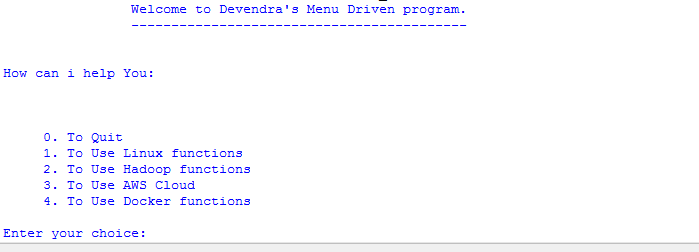
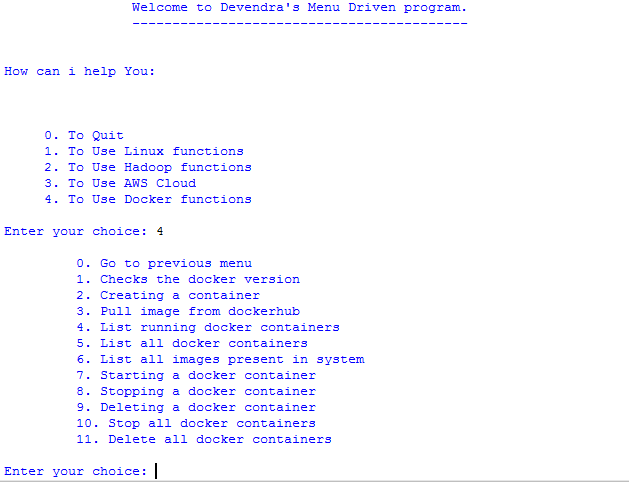
The program I developed uses a simple Python script (python_menu.py) that brings the power of automation to your fingertips. When you run it, you’re greeted with a menu that lets you perform operations on:

  • Linux: Manage basic operations effortlessly.
  • Hadoop: Set up and manage big data solutions.
  • AWS: Handle cloud computing tasks like managing EC2 instances.
  • Docker: Simplify containerization workflows.

This program bridges the gap between specialized knowledge and accessibility, letting even newcomers execute powerful commands with ease.

menu-1

Pre-Requisites

Before you dive in, here’s what you need to have set up:

  • Python 3: The backbone of the program.
  • Linux OS: The platform this script operates on.
  • Hadoop Configuration: For big data tasks.
  • AWS CLI: For managing AWS services.
  • Docker Installed: To handle containerization.

What Can It Do?

Here’s a deeper look at what this program brings to the table:

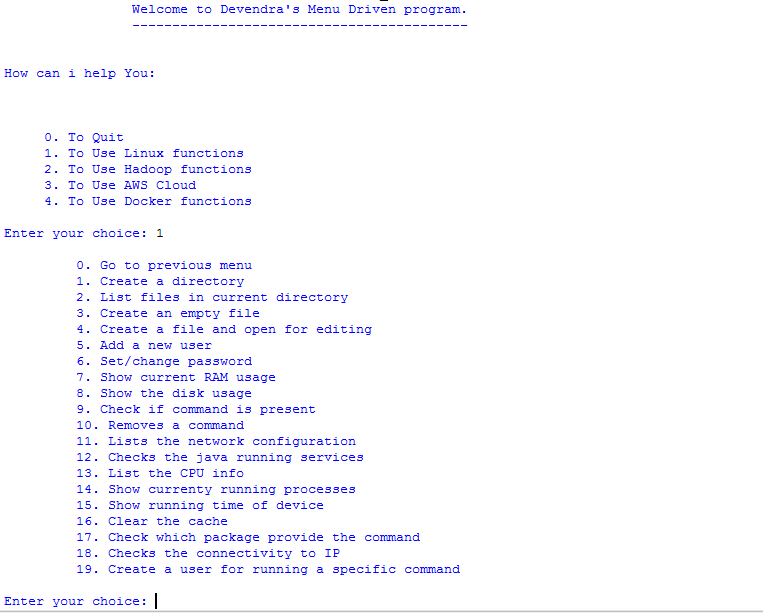
1. Linux Operations

Linux is the foundation of most server environments, and this program simplifies basic operations.
Example: Need to check disk usage, list files, or set permissions? Just select the corresponding menu option, and you’re done.

Linux
Linux

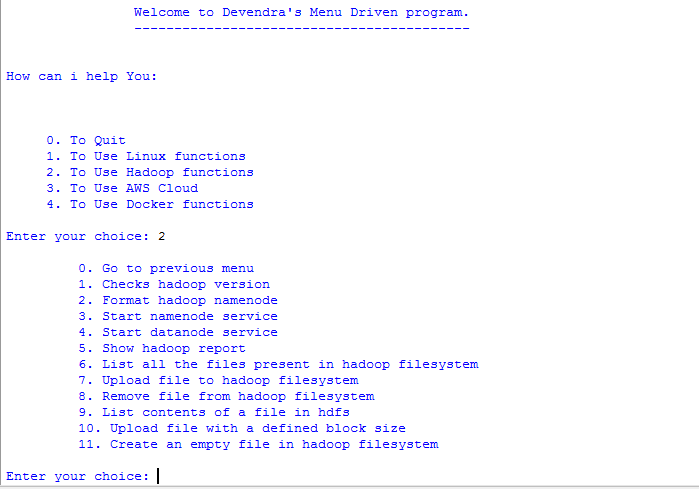
2. Hadoop Operations

Big data can be intimidating, but Hadoop’s distributed framework makes handling massive datasets possible.
Practical Use Case: You can set up a Hadoop cluster, format the namenode, or check the cluster’s health—all through this menu.
Imagine a data engineer setting up a Hadoop environment for processing terabytes of log data. Instead of typing commands repeatedly, they select options from this menu and finish in minutes.

Hadoop

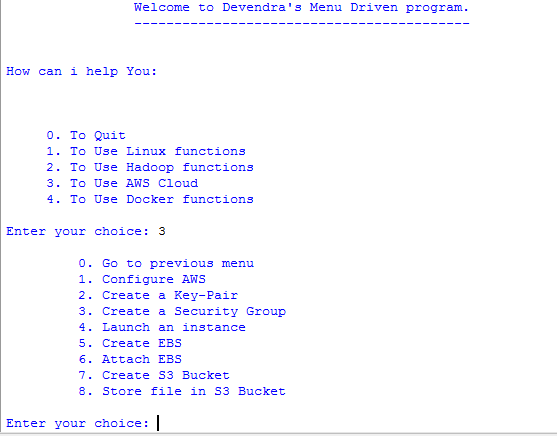
3. AWS Operations

Cloud computing is the present and the future.
Highlights:

  • Launch EC2 instances effortlessly.
  • Start, stop, or terminate servers.
  • Configure S3 buckets for storage.
    Scenario: A startup deploying a web application can use this menu to quickly launch and configure their cloud servers without manually navigating AWS’s dashboard.
AWS

4. Docker Operations

Containerization is essential for modern development workflows. Docker’s lightweight containers isolate applications, making deployment consistent and scalable.
Example: Developers can build images, run containers, and monitor their states—all by selecting options in the program.

Docker


Why Build a Menu Program?

Creating this menu-driven program wasn’t just about simplifying tasks; it was also about bringing together diverse technologies in one cohesive interface.

Here’s what makes it special:

  • Ease of Use: No need to memorize commands or scripts.
  • Error-Free Execution: Automating repetitive tasks reduces human error.
  • Time-Saving: Quickly perform complex tasks with minimal effort.
  • Scalability: As I find new technologies to automate, adding them to this program is straightforward.

Behind the Scenes: Developing the Program

This program is a Python-based project that uses libraries like subprocess to execute commands in the terminal. Each menu option corresponds to a predefined function, which runs specific system commands or scripts for the selected technology.

Challenges Faced

  • Integrating Technologies: Ensuring seamless operation across Linux, Docker, Hadoop, and AWS required detailed testing.
  • Error Handling: Building robust error-checking mechanisms for unexpected failures was essential.
  • User-Friendly Design: Making the menu intuitive and non-intimidating for beginners was a priority.

  • Why Hostinger Is the Best Hosting for Bloggers 2026

    Why Hostinger Is the Best Hosting for Bloggers 2026

    Why Hostinger Is the Best Web Hosting for Bloggers and Content Creators in 2026 Hostinger is one of the best web hosting providers for bloggers and content creators in 2026. With fast loading speeds, affordable pricing, free SSL, and beginner-friendly WordPress tools, Hostinger helps creators build high-performing websites with ease. If you’re a blogger or

    read more

  • Nil ITR: 5 Important Benefits Even If Your Tax Is ₹0

    Nil ITR: 5 Important Benefits Even If Your Tax Is ₹0

    अगर आपका टैक्स ₹0 है, तब भी Nil ITR फाइल करना बेहद जरूरी हो सकता है। आज के डिजिटल टैक्स सिस्टम में Income Tax Department के पास AIS, TIS, बैंक और TDS का पूरा डेटा पहले से मौजूद होता है। इसलिए Nil ITR सिर्फ एक फॉर्मेलिटी नहीं, बल्कि आपकी फाइनेंशियल सुरक्षा का मजबूत आधार है।

    read more

  • International students in Australia are facing significant adjustments to their post-study career plans

    following recent shifts in the country’s Post-Study Work (PSW) visa regulations. These changes, aimed at recalibrating Australia’s skilled migration pathways, introduce new requirements and revised eligibility criteria that could profoundly impact graduates aspiring to gain work experience after completing their studies. As the dust settles on these policy updates, Kalinka Infotech emphasizes the critical need

    read more

Real-Life Applications and Benefits

1. For Students and Beginners

Imagine being a computer science student exploring cloud computing. Instead of wrestling with AWS’s interface or Docker commands, you can focus on learning concepts while the menu handles the heavy lifting.

2. For IT Professionals

Picture an IT admin managing multiple servers daily. With this tool, they can automate routine tasks, leaving them more time for strategic projects.

3. For Developers

Developers can use the program to quickly spin up containers, test deployments, or simulate distributed systems using Hadoop clusters.


Looking Ahead: Expanding the Program

While the current version focuses on Linux, Hadoop, AWS, and Docker, I’m constantly exploring new ways to enhance it. Future updates might include:

  • Kubernetes Integration: Automate container orchestration.
  • Database Management: Simplify operations for MySQL, PostgreSQL, and more.
  • Monitoring Tools: Add options for logging and performance monitoring.

Conclusion

In a world where time is the most valuable resource, automation is your best ally. Whether you’re managing cloud servers, running containers, or analyzing big data, this menu-driven program can transform how you work.

Don’t just dream about making life easier start building tools that do the work for you. If I could simplify these technologies into a single Python script, imagine what you could create!

What would you automate? Share your ideas in the comments below!

What Is Data Engineering and How to Get Started?

Data Engineering: The Backbone of Modern Decision-Making

Data is the lifeblood of the modern world. Every swipe, click, and stream generates data. But have you ever wondered what happens to all that data? How does Netflix know exactly what you want to watch, or Amazon suggest products you didn’t know you needed? The answer lies in data engineering an essential yet often overlooked field that powers the data-driven decisions we take for granted.

Data Engineering
Data Engineering

In this blog, let’s explore what data engineering is, why it matters, and how it shapes everything from business strategies to your daily coffee order. By the end, you’ll see why data engineers are the unsung heroes of the digital age.


What is Data Engineering?

At its core, data engineering is the process of designing, building, and maintaining systems that collect, store, and process data. Think of data engineers as architects and plumbers for data. They ensure that data flows smoothly from its source (like a website or app) to storage systems (like a data warehouse) and then to end-users (data scientists, analysts, or machine learning models).

Key Responsibilities of a Data Engineer

  • Data Pipelines: Building and managing the flow of data from point A to point B.
  • ETL (Extract, Transform, Load): Cleaning and transforming raw data into usable formats.
  • Data Storage: Designing databases and warehouses that can handle large volumes of data.
  • Optimization: Ensuring systems are fast, scalable, and cost-efficient.

Why is Data Engineering Important?

Imagine a company generating terabytes of data daily. Without a proper system, this data would be like a messy attic—full of valuable things but impossible to navigate. Data engineers turn this mess into organized shelves, making it easy for others to find what they need.

Real-Life Impact

  • E-commerce: Platforms like Amazon and Flipkart rely on clean, accessible data to recommend products and optimize inventory.
  • Healthcare: Hospitals use data pipelines to analyze patient records, improving diagnostics and treatments.
  • Entertainment: Netflix’s personalized recommendations are fueled by well-structured data.

Without data engineering, the insights we rely on daily would be buried under chaos.


A Day in the Life of a Data Engineer

When I first started as a data engineer, I thought it was all about coding. But the reality is much more dynamic and challenging.

Morning: Handling Data Pipelines

The day often begins with checking pipelines. Is the nightly batch job still running? Did yesterday’s data successfully load into the warehouse?

Example: One morning, a sales dashboard was blank because a pipeline processing transaction data failed. Debugging revealed an unexpected data format change from an external vendor. It was a race against time to fix it before the sales team noticed!

Afternoon: Building New Features

This is when creativity comes into play. Maybe marketing wants a new campaign report, or the product team needs real-time user activity tracking.

Personal Anecdote: I once worked on a pipeline to integrate real-time user feedback into a product recommendation system. Seeing the feature improve user engagement was incredibly rewarding.

Evening: Planning and Optimization

The day wraps up with long-term planning. How can we make pipelines faster? Are there better tools or practices we can adopt?

Practical Advice: Always document your work! Future you (or your team) will thank you when debugging a complex system six months later.


Tools of the Trade

Data engineers rely on a mix of tools and technologies to manage workflows. Here are some of the most common ones:

Programming Languages

  • Python: Ideal for ETL jobs and data manipulation.
  • SQL: The bread and butter for querying databases.

Data Storage

  • Relational Databases: MySQL, PostgreSQL.
  • Big Data Systems: Hadoop, Apache Hive.
  • Cloud Solutions: AWS Redshift, Google BigQuery.

Workflow Orchestration

  • Apache Airflow: For managing complex workflows.
  • Luigi: A simpler alternative for task scheduling.

Streaming Data

  • Apache Kafka: For real-time data pipelines.

Challenges in Data Engineering

While the field is exciting, it’s not without hurdles:

  1. Data Quality: Garbage in, garbage out. Ensuring clean, accurate data is harder than it sounds.
  2. Scalability: A solution that works for 10,000 records might crumble under a million.
  3. Keeping Up with Trends: Technology evolves rapidly, and staying current is a constant challenge.

Pro Tip: Always have monitoring and alerts in place. It’s better to catch issues early than deal with angry stakeholders later.


How to Get Started in Data Engineering

Whether you’re a student or a professional looking to switch careers, data engineering offers immense opportunities.

Skills to Learn

  1. Programming: Start with Python and SQL.
  2. Data Modeling: Understand how to structure data for efficiency.
  3. Cloud Platforms: Familiarize yourself with AWS, Azure, or Google Cloud.
  4. Big Data: Learn Hadoop or Spark for large-scale processing.

Build Projects

The best way to learn is by doing. Create a project like a pipeline that collects and analyzes weather data from APIs.

Example: During a personal project, I built a system that processed Twitter data in real time to track trending topics. It was a fun way to combine technical skills with creativity.


The Future of Data Engineering

The demand for data engineers is skyrocketing as organizations increasingly rely on data to stay competitive. Emerging trends like real-time analytics, machine learning, and edge computing are reshaping the field.

What’s Next?

  • DataOps: Applying DevOps principles to data workflows.
  • AI Integration: Automating pipeline optimizations using machine learning.
  • Serverless Architectures: Reducing infrastructure management with serverless platforms like AWS Lambda.

  • Why Hostinger Is the Best Hosting for Bloggers 2026

    Why Hostinger Is the Best Hosting for Bloggers 2026

    Why Hostinger Is the Best Web Hosting for Bloggers and Content Creators in 2026 Hostinger is one of the best web hosting providers for bloggers and content creators in 2026. With fast loading speeds, affordable pricing, free SSL, and beginner-friendly WordPress tools, Hostinger helps creators build high-performing websites with ease. If you’re a blogger or

    read more

  • Nil ITR: 5 Important Benefits Even If Your Tax Is ₹0

    Nil ITR: 5 Important Benefits Even If Your Tax Is ₹0

    अगर आपका टैक्स ₹0 है, तब भी Nil ITR फाइल करना बेहद जरूरी हो सकता है। आज के डिजिटल टैक्स सिस्टम में Income Tax Department के पास AIS, TIS, बैंक और TDS का पूरा डेटा पहले से मौजूद होता है। इसलिए Nil ITR सिर्फ एक फॉर्मेलिटी नहीं, बल्कि आपकी फाइनेंशियल सुरक्षा का मजबूत आधार है।

    read more

  • International students in Australia are facing significant adjustments to their post-study career plans

    following recent shifts in the country’s Post-Study Work (PSW) visa regulations. These changes, aimed at recalibrating Australia’s skilled migration pathways, introduce new requirements and revised eligibility criteria that could profoundly impact graduates aspiring to gain work experience after completing their studies. As the dust settles on these policy updates, Kalinka Infotech emphasizes the critical need

    read more

Final Thoughts

Data engineering may not always be glamorous, but it’s the foundation upon which modern businesses stand. As a data engineer, you’re not just dealing with numbers; you’re enabling decisions that impact millions of lives.

So, whether you’re recommending a movie, optimizing a supply chain, or fighting a pandemic, remember every piece of data tells a story. And as a data engineer, you’re the storyteller’s most trusted ally.

What’s your favorite aspect of data engineering? Let me know in the comments I’d love to hear your story!

How to Create a Powerful LinkedIn Profile and Summary

How to Create a Powerful LinkedIn Profile and Summary

Having a robust LinkedIn profile is essential in today’s professional world. Whether you’re job-hunting, networking, or showcasing your career, your LinkedIn profile is your digital business card. A standout summary ties it all together and can make you unforgettable.

Understanding Your LinkedIn Profile

Your LinkedIn profile isn’t just a resume; it’s your story told online. But to succeed, all its pieces must work together to tell a cohesive narrative. Here are the building blocks.

Profile Photo and Header

Photo by Zx Teoh

Your profile photo is your first handshake. A professional headshot makes a world of difference. Avoid casual selfies or outdated photos that don’t reflect the professional world.

The header, that banner behind your headshot, should complement your career. Whether it’s a sleek design, your company logo, or an image tied to your industry, it’s a space worth using.

Headline and Summary

Your headline is more than your current job title. It’s your elevator pitch. Instead of “Accountant,” say something like, “Helping businesses thrive through strategic financial planning.” It’s short but gives value.

The summary is where you expand. This section lets visitors see who you are beyond titles. It’s a platform for achievements, aspirations, and personality.

Writing an Effective Summary

A summary doesn’t just list facts. It connects the dots between your past, present, and future work goals. The best ones spark curiosity and resonate.

Start with a Hook

The first two lines matter most. Why? Because LinkedIn cuts your summary preview short. A compelling hook might be:
“I turn complex problems into simple solutions. For 10 years, I’ve been helping businesses save time and money.”

This grabs attention and makes someone want to click “see more.”

Showcase Your Journey

What makes you unique? Talk about your professional experiences using a narrative flow. Instead of listing roles, share what you learned or how you made an impact.

For example: “I began my journey as a marketing intern, where I mastered campaigns that boosted engagement by 25%. Today, I lead a team to achieve even greater growth.”

Include Keywords

LinkedIn is a search engine too. Incorporate keywords that recruiters or peers are likely to search for in your industry. Are you a data scientist? Sprinkle terms like “machine learning,” “AI,” or “big data” naturally.

Encourage Engagement

Invite connection requests or collaborations in your summary. For example: “If you’re looking to collaborate or just connect, feel free to send me a message!”

Common Mistakes to Avoid

Not optimizing your profile can cost you opportunities. Avoid these frequent errors that hold people back.

Generic and Clichéd Language

Buzzwords like “team player” or “results-oriented” won’t set you apart. Describe specific accomplishments using strong, clear language instead.

Neglecting the Profile Photo

Skipping a profile photo can make you seem inactive. Worse, a low-quality or unprofessional image can hurt trust immediately.

Ignoring Updates

Don’t let your profile turn stale. Regular updates keep it relevant and show you’re active in your field. Added a new skill? Completed a key project? Update your profile.

Utilizing LinkedIn Features

Extra LinkedIn tools let you shine brighter. Use them to amplify your credibility.

Recommendations and Endorsements

Ask colleagues or clients for recommendations. These personal reviews validate your skills and expertise. Even one recommendation can make your profile appear more dynamic.

Endorsements for skills are an easier way to get noticed, so list relevant ones and encourage connections to endorse them.

  • Why Hostinger Is the Best Hosting for Bloggers 2026

    Why Hostinger Is the Best Hosting for Bloggers 2026

    Why Hostinger Is the Best Web Hosting for Bloggers and Content Creators in 2026 Hostinger is one of the best web hosting providers for bloggers and content creators in 2026. With fast loading speeds, affordable pricing, free SSL, and beginner-friendly WordPress tools, Hostinger helps creators build high-performing websites with ease. If you’re a blogger or

    read more

  • Nil ITR: 5 Important Benefits Even If Your Tax Is ₹0

    Nil ITR: 5 Important Benefits Even If Your Tax Is ₹0

    अगर आपका टैक्स ₹0 है, तब भी Nil ITR फाइल करना बेहद जरूरी हो सकता है। आज के डिजिटल टैक्स सिस्टम में Income Tax Department के पास AIS, TIS, बैंक और TDS का पूरा डेटा पहले से मौजूद होता है। इसलिए Nil ITR सिर्फ एक फॉर्मेलिटी नहीं, बल्कि आपकी फाइनेंशियल सुरक्षा का मजबूत आधार है।

    read more

  • International students in Australia are facing significant adjustments to their post-study career plans

    following recent shifts in the country’s Post-Study Work (PSW) visa regulations. These changes, aimed at recalibrating Australia’s skilled migration pathways, introduce new requirements and revised eligibility criteria that could profoundly impact graduates aspiring to gain work experience after completing their studies. As the dust settles on these policy updates, Kalinka Infotech emphasizes the critical need

    read more

Content Sharing and Networking

Don’t stop at having a polished profile. Share industry-relevant posts, write articles, and engage with others in your field. This activity showcases leadership and helps build your network.

Conclusion

A strong LinkedIn profile and summary are your ticket to standing out in a crowded job market. From a polished photo to an engaging summary, every detail counts. Keep updating, stay relatable, and remember: your LinkedIn is your online first impression. Make it count—start optimizing today!